How to Protect Your Home From Termites in Pakistan
Termites are one of the most destructive, and most overlooked, threats to homes in Pakistan. A colony can quietly hollow out your wooden doors, window frames, furniture, and even structural elements over months before you notice a single sign. In Lahore’s climate, with its hot summers and monsoon humidity, conditions are almost ideal for termite activity. If you’re building, renovating, or simply maintaining a home, understanding how to protect your home from termites in Pakistan is not optional, it’s essential.
This guide covers what actually works: pre-construction soil treatment, post-construction barriers, product choices, costs in PKR, and the warning signs you should never ignore.
Why Termites Are a Serious Problem in Lahore
Pakistan — and Punjab in particular — is home to subterranean termites (Coptotermes and Heterotermes species), which live in the soil and tunnel upward into structures. Unlike dry-wood termites common in coastal climates, subterranean termites build mud tubes and attack from the ground up, which means your plinth, DPC layer, timber frames, and ground-floor woodwork are at highest risk.
Lahore’s clay-heavy soil retains moisture well — exactly what termite colonies need to thrive. Areas with older drainage systems or high water tables, including parts of Gulberg, Model Town, and older Defence sectors, tend to see heavier infestation. Even newer developments in Bahria Town and DHA Phase 7–9 are not immune, especially during and after construction when soil is disturbed and moist.
Pre-Construction Termite Treatment: The Most Effective Stage
If you’re building from scratch, this is where to spend your money. Pre-construction anti-termite treatment (ATT) involves applying a chemical barrier to the soil before the concrete slab or plinth is laid. It is far more effective — and cheaper — than treating an existing structure.
How Pre-Construction Treatment Works
- The subgrade soil is treated with a diluted termiticide solution at the time of excavation and backfilling.
- Treatment is applied around the perimeter of the foundation, under the floor slab, and at expansion joints.
- A second treatment is done at plinth level before DPC (Damp Proof Course) and floor slab are cast.
- The chemical creates a continuous toxic barrier that termites cannot cross without exposure.
Approved Chemicals Used in Pakistan
The most widely used termiticides in Pakistan are Chlorpyrifos and Imidacloprid-based products. Chlorpyrifos has been the industry standard for decades and is still effective when properly applied. Imidacloprid (sold under brands like Premise and Biflex) is newer, less toxic to humans, and longer-lasting — typically 5–10 years versus 3–5 for Chlorpyrifos. Always use a licensed pest control operator (PCO) who can confirm the product is registered with Pakistan’s Department of Plant Protection.
Pre-Construction ATT Cost in Pakistan (2026)
| Plot Size | Approx. Treatment Area | Estimated Cost (PKR) |
|---|---|---|
| 5 Marla | 1,125 sq ft | Rs. 15,000 – Rs. 30,000 |
| 10 Marla | 2,250 sq ft | Rs. 25,000 – 50,000 |
| 1 Kanal | 4,500 sq ft | Rs. 45,000 – Rs. 90,000 |
Rates vary significantly by contractor, chemical used, and site conditions. Always get at least two quotes and ask for a written treatment warranty.
Post-Construction Termite Treatment
If your home is already built — grey structure stage or fully finished — you still have options, though treatment is more invasive and less complete than pre-construction barriers.
Drill-and-Inject Method
This is the most common post-construction approach in Pakistan. The contractor drills holes (typically 12mm diameter) at 30–45 cm intervals along the internal and external perimeter walls at floor level, then injects a termiticide solution under pressure. Holes are then sealed with cement. This creates a chemical barrier around the base of the structure.
Soil Rodding Around the Foundation
For external treatment, steel rods are used to create injection points in the soil around the foundation perimeter. Termiticide is pumped in at depth, targeting the subterranean colony pathways. This is often done alongside the drill-and-inject method for full coverage.
Baiting Systems
Bait stations (such as Sentricon or local equivalents) are installed in the soil around the home. Termites feed on the bait and carry it back to the colony, eventually collapsing it. Baiting is slower than chemical barriers but is less disruptive and increasingly popular for finished homes or where chemical injection isn’t feasible. Expect to pay Rs. 80,000 – Rs. 200,000+ for a full baiting system on a 10 marla home, depending on the brand and number of stations.
Structural Design Choices That Reduce Termite Risk
Good construction decisions reduce your exposure before any chemical is applied. When planning your build, discuss these with your contractor:
- DPC at plinth level: A properly laid Damp Proof Course using bitumen or polyethylene sheeting cuts off moisture pathways — and termites follow moisture. If your DPC is missing or poorly done, you’re vulnerable.
- Avoid wood-to-soil contact: Never let timber door frames, wooden shuttering debris, or formwork rest directly against soil. Clear all timber off-cuts from the site before backfilling.
- RCC frames instead of wood: Using RCC (reinforced cement concrete) door and window frames eliminates the termites’ primary food source. In Pakistan’s high-risk areas, this is often worth the extra cost over wood.
- Raised plinths: A plinth height of at least 450mm (18 inches) above finished ground level makes it easier to spot mud tubes and harder for termites to bridge to the structure.
- Good drainage design: Standing water near the foundation is an open invitation. Grade your site so rainwater drains away from the structure, not toward it.
Warning Signs of Termite Infestation
Catching an infestation early limits the damage. Train yourself — and your chowkidar — to look for these signs, especially after monsoon season:
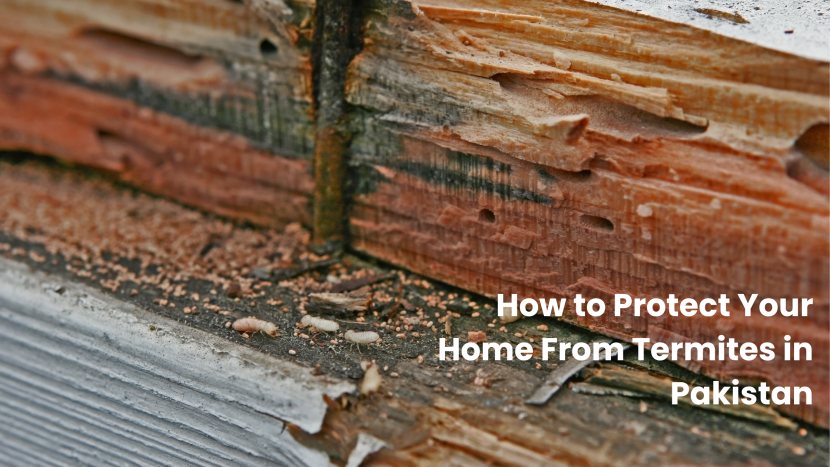
- Mud tubes: Pencil-thin tunnels of soil running up walls, foundation edges, or behind skirting boards. This is the most reliable sign of subterranean termite activity.
- Hollow-sounding wood: Tap wooden doors, frames, and skirting — a hollow or papery sound means termites may have eaten through the interior.
- Blistered or bubbling paint: Looks like water damage but occurs in dry areas — often caused by termites tunneling beneath the surface.
- Discarded wings (alates): After a swarm, reproductive termites shed their wings. Finding small piles of wings near windows or light sources is a clear warning.
- Frass (termite droppings): Tiny, pellet-like droppings near wood. More common with dry-wood termites but worth knowing.
- Damaged skirting, door frames, or furniture: If wood feels soft, crumbles at the edges, or has fine tunnels running through it, act immediately.
Protecting Your Furniture and Woodwork
Structure aside, your doors, window shutters, kitchen cabinets, and furniture are also at risk. A few practical steps:
- Use seasoned hardwood (sheesham/rosewood is naturally more resistant) for furniture and built-ins rather than cheap softwood.
- Apply a wood preservative (boric acid-based or commercial termite-resistant varnish) to all timber before installation. This is especially important for door frames fitted into masonry.
- Keep furniture away from damp walls. Moisture is the bridge between termites in the soil and wood in your rooms.
- If you’re having custom furniture made, ask the carpenter to pre-treat the wood — most will do it for a small additional charge.
Choosing the Right Pest Control Company in Lahore
The quality of the treatment depends almost entirely on the applicator. Here’s what to look for and ask before signing anything:
- License and registration: The company should be registered with the Punjab Pest Management Authority or hold valid DPP certification.
- Written treatment plan: Ask for a site-specific treatment plan showing drill locations, chemical dilution ratios, and coverage map. Serious operators provide this.
- Written warranty: A reputable company offers a minimum 1–5 year warranty with free re-treatment if infestation recurs. Get it on paper.
- Chemical disclosure: Ask exactly which chemical, at what concentration, will be used. “Our own formula” is a red flag.
- References: Ask for two or three recent jobs in your area and follow up with those homeowners.
In Lahore, established companies like Fumigation Services (Pvt) Ltd and several DHA-approved contractors have long track records, but independent operators can also be competent — the checklist above applies regardless of company size.
Ongoing Maintenance: Don’t Treat Once and Forget
Chemical barriers degrade over time. Even the best Imidacloprid treatment has a finite life. Build termite inspection into your annual home maintenance routine:
- Inspect mud tube hotspots (foundation perimeter, bathroom walls, under staircases) every 6 months — especially after monsoon.
- Schedule a professional inspection every 2–3 years even if you see no visible signs.
- If you’ve had treatment done, check your warranty expiry date and arrange renewal treatment before it lapses.
- Log any signs you spot (photo, location, date) so your pest control company has a clear treatment history.
Thinking about a full home construction plan? Our guide on grey structure construction and finishing costs in Lahore walks you through budgeting for every stage, including protective treatments. And if you’re in the early planning phase, understanding what a proper BOQ should include can help you ensure termite treatment is costed from day one — not added as an afterthought.
Quick-Reference Termite Protection Checklist
| Stage | Action | Priority |
|---|---|---|
| Pre-construction | Soil treatment before slab / plinth | Essential |
| Construction | Proper DPC, raised plinth, remove timber debris | Essential |
| Finishing | Pre-treat all timber frames and built-ins | High |
| Post-construction | Drill-and-inject / baiting if untreated | High |
| Ongoing | Biannual inspection, warranty renewal | Medium |
| Any stage | Fix leaks, improve drainage, reduce moisture | High |
Frequently Asked Questions
How much does termite treatment cost in Pakistan for a 10 marla house?
For pre-construction treatment, expect to pay roughly Rs. 25,000 – Rs. 50,000 for a 10 marla plot, depending on the chemical and contractor. Post-construction drill-and-inject treatment on a finished 10 marla home typically runs Rs. 35,000 – Rs. 80,000. Baiting systems cost more — sometimes Rs. 100,000–200,000 — but offer longer-term colony elimination. Always get written quotes; prices vary considerably across Lahore.
Is pre-construction termite treatment mandatory in DHA or Bahria Town Lahore?
Neither DHA Lahore nor Bahria Town currently mandates anti-termite treatment as a formal approval condition, but both strongly recommend it and many of their approved contractors include it in standard construction packages. Given the cost of an infestation versus the cost of prevention, skipping it to save money is a poor trade-off.
Can termites damage RCC or brick walls — or only wood?
Termites don’t eat concrete or brick, but they will tunnel through cracks, expansion joints, and hollow blocks to reach wood on the other side. They can also damage electrical wiring insulation, foam insulation boards, and paper-faced drywall if present. The structural masonry itself is safe, but everything inside it — frames, fixtures, finishes — is at risk without a proper chemical barrier.
What’s the difference between termites and white ants in Pakistan?
“White ants” is simply the common local term for termites — they are the same insect. True ants and termites are unrelated species with very different behavior. Termites have a straight waist, equal-length wings (when present), and straight antennae; ants have a pinched waist, unequal wings, and elbowed antennae. If you’re seeing white, soft-bodied insects in or around your wood, assume termites and get an inspection.
Protecting your home from termites in Pakistan is most effective — and most affordable — when built into the construction plan from the start. If you’re currently planning a build or renovation in Lahore and want to make sure termite treatment is properly specified and costed, get in touch with the IHS team. We can help you put together a complete construction plan that accounts for protection from the ground up.